01 December, 2008

Make Your Plans on That Basis.


On Wednesday 23 October 1929, Huey Long, governor of Louisiana, was lounging in the lobby of the Roosevelt Hotel in New Orleans. A local bank president ran up to him, nearly hysterical, exclaiming, "Governor! Hell's broken loose! The biggest crash you've ever seen! It's going to be sixty days before this country will get back to normal."

Governor Long replied calmly, "I've been expecting this crash for three years. It's here for many, many years. It can't end until there's a redistribution of wealth. Make your plans on that basis."

06 November, 2008

An Italo-American Faust


Born in New Jersey, Francis Sinatra had a formidable mother, active in Democratic city ward politics. He knew at first hand the politics of immigrant Italians, of the urban working class. He was one of them.

What interests me is the rise and fall of a political hero whose apothëosis, or, to be precise, hell, was to become a neutered creature of the American right wing, crooning in Nancy Reagan’s ear at the White House.


At the height of his popular fame as a singer, Frank Sinatra made a short documentary called The House I Live In. This was in 1947; he won an Academy Award for the song, whose lyrics — The people that I work with. The workers that I meet ... The right to speak my mind. That is America to me — were a straightforward pleas for tolerance that neither cloyed nor bored.

Sinatra then fell foul of the FBI, and the professional patriots, and the then powerful Hearst press. In the course of the next eight years, Congress's Un-American Activities Committee, in its Index "of Communists" named The House I Live In twelve times while the New York Times, forever up to no good, in its Index for 1949 published a cross-reference: "Sinatra, Frank: see U.S. — Espionage." That was all the news fit to print about our greatest popular singer.

To add to the demonization, one Harry Anslinger, head of the Federal Narcotics Bureau, and the FBI’s ineffable J. Edgar Hoover (who lived long enough to keep a file on the subversions and perversions of John Lennon), were out to get Sinatra not only as a crypto-Communist but as a mafioso. Since any nightclub singer must work in a nightclub or a casino and since the mob controlled these glittering venues, every entertainer was obliged to traffic with them.

In 1947 Sinatra was smeared as a mafioso by a right-wing Hearst columnist, Lee Mortimer. Sinatra, notoriously short-tempered and not unfamiliar with fiery waters, knocked Mortimer down in a nightclub. Press ink flowed like Niagara Falls. Sinatra was transformed by the right-wing press overnight from the crooning idol of bobby-soxers into violent, left-wing mafioso.

Catholic organs, respectful of their co-religionist’s fame, tried to downplay the attacks, maintaining that he was a mere “pawn.” But he wasn’t. Sinatra had indeed been active in left-wing (by American standards) activities. In 1946 he blasted Franco, a favorite of America’s High Command. That same year he became vice-president of the Hollywood Independent Citizens Committee of the Arts, Sciences and Professions, along with many other stars and Thomas Mann.

In 1948 he supported Henry Wallace for President against the proto-McCarthyite Harry S. Truman. Undeterred by the harm to his career, Sinatra wrote an open letter to the then liberal New Republic imploring Henry Wallace, as heir to Roosevelt, “to take up the fight we like to think of as ours — the fight for tolerance, which is the basis of any fight for peace.” Three months later he was publicly branded a Communist and sacked from his radio show; by 1949 Columbia Records had broken with him and by 1950 MGM dismissed him from his film contract.

A has-been at thirty-four.

After a time of trouble with his wive, Ava Gardner, and the loss of his voice due to alcohol and stress, he made his astonishing come-back in the film From Here to Eternity, for which he was obliged to take a minimal salary. He also developed a brand-new voice, grace notes like Mabel Mercer.


By 1960 Sinatra was again political. He had been a playmate of Jack Kennedy in his senatorial days; he was also gung-ho to help out his conservative but attractive Catholic friend. But some Kennedy advisers thought the Red Mafioso should be avoided at all costs, others wanted to use him for a voter drive in Harlem “where he is recognized as a hero of the cause of the Negro,” something that Kennedy was not, to say the least.

Although, at times, Sinatra seemed to be ranging between megalomania and just plain hard drinking, he was still a major singer, also a movie star, famous for doing scenes in only one take — known in the trade as “walking through.” Kennedey’s candidacy revved him up. But for those who have wondered what dinner might have been like for Falstaff when Prince Hal — now King — snubbed him, I can report that after Kennedy was nominated in Los Angeles at the convention where I was a delegate, Tony Curtis and Janet Lee gave a movie-star party for the nominee. I was placed, along with Sinatra, at the table where Kennedy would sit. We waited. And Waited. Sinatra looked edgy; started to drink heavily. Diner began. Then one of the toothy sister of the nominee said, casually, “Oh, Jack’s sorry. He can’t come. He’s gone to the movies.” Opposite me, Falstaff deflated and spoke no more that evening.

Once Kennedy was elected, Sinatra organized the inaugural ball. But the President’s father and brother Robert said no more Sinatra and there was no more Sinatra.

When President Kennedy came to stay in Palm Springs, he stayed not with Sinatra, as announced, but with his rival Bing Crosby. Insult to injury. From then on, in public and private, he often behaved boorishly.

In due course, he was called before a Congressional committee on the Mafia. They got nowhere. Nowhere to go. Nowhere for him, either. He became a Reagan Republican. But then no Democratic President asked him to perform at the White House. It was sly old Nixon, whose House committee had smeared him, who asked Sinatra to sing The House I Live In.

At the end of the program, for the first time in his public career, Sinatra was in tears. It is not easy to be good, much less a tribune of the people, in the land of milk and money once your house is gone.

— Gore Vidal, 17 May 1998


29 October, 2008

Time to Face Facts in Afghanistan

The current war in Afghanistan is not really about al-Qaida and `terrorism,’ but about opening a secure corridor through Pashtun tribal territory to export the oil and gas riches of the Caspian Basin of Central Asia to the West. The US and NATO forces in Afghanistan are essentially pipeline protection troops fighting off the hostile natives..

Both Barack Obama and John McCain are wrong about Afghanistan. It is not a `good’ fight against `terrorism,’ but a classic, 19th century colonial war to advance western geopolitical power into resource-rich Central Asia. The Pashtun Afghans who live there are ready to fight for another 100 years. The western powers certainly are not.


17 October, 2008

After Nine Years

The Glass-Steagall Act of 1933 was a key New Deal reform designed to prevent the kind of credit melt-down that took place from 1929-1933. It separated commercial banking from investment banking, established the Federal Deposit Insurance Corporation (FDIC), and included reforms designed to control speculation.

Provisions such as Regulation Q, which allowed the Federal Reserve to regulate interest rates in savings accounts, were repealed by the Depository Institutions Deregulation and Monetary Control Act of 1980. This lead to the Savings and Loan crisis of the 1980's, which cost taxpayers about $124.6, either directly or through charges on their savings and loan accounts and which contributed to the large budget deficits of the early 1990s. The concomitant slowdown in the finance industry and the real estate market was a primary cause of the 1990–1991 economic recession.

Provisions of the Glass-Steagall Act prohibiting a bank holding company from owning other financial companies were repealed on November 12, 1999, by the Gramm-Leach-Bliley Act, which passed in the Senate: 90-8-1 and was signed into law by President Bill Clinton.

At the time one of the few senators to vote against the Gramm-Leach-Bliley Act,Byron Dorgan, made the following prediction:
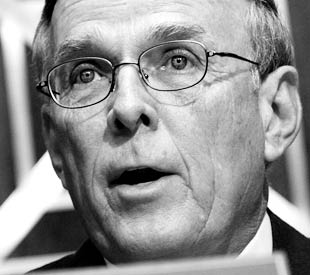

"I think we will look back in ten years' time and say we sould not have done this, but we did because we forgot the lessons of the past, and that which is true in the 1930s is true in 2010."
10 October, 2008

By The Numbers

Here is a chart of the composition of the Supreme Court by party affiliation since Roe v. Wade in 1973:


You will note that it was then, and has remained, overwhelmingly Republican. That's right
— Roe v. Wade was put through by a court that was 2/3 Republican! Since then, the balance has gotten even more lop-sided, why, there was a period there when Byron White was the only Democrat on the court!

So — do you expect me to believe that one more Republican appointed justice might just tip the balance? That we have to vote Republican to keep the Supreme Court from "going Democratic?"

Let me assure you that, based on the record, we can count on Republican justices to:

• Not over-turn Roe v. Wade. (e.g.
McCorvey v. Hill)

• Undermine the rights of citizens to sue corporations (
e.g. Riegel v. Medtronic, Inc.)

• Undermine our Bill of Rights (e.g. ACLU v. NSA)

• Steal elections from the people (e.g. Bush v. Gore)