


02 January, 2014
Attention Citizens
In 1957, Ernst Junger, in his novel "The Glass Bees," predicted that the Zapparoni Works (a manufacturer of tiny drones or "glass bees") would rule the world by monitoring everyone's typewriter strokes. Is that


06 November, 2013
Why Capitalism (literally) Stinks
John Ralston Saul comments very presciently
on the idea that the market works for the general good in his book “Voltaire’s
Bastards: The Dictatorship of Reason in the West” (The Free Press, New York
City, 1992).
Take public heath, for example. In the late seventeenth century Paris was without a sanitary system — its streets were a gigantic latrine for five hundred thousand people. The terraces of the king's palace — the Tuileries — smelled so strong that no one dared go onto them except to relieve themselves.At that point in history, the modern administrative structure was in its infancy, limited to little more than the maitres de requétes. An early form of ombudsmen, they were judges who listened to complaints and requests addressed to the king. Richelieu had not even begun his razing of city walls with the idea of making central administrative control possible.One hundred and fifty years later, in 1844, very little had changed. Six hundred thousand of the 912,000 residents of Paris lived in slums. At Montfaucon, in the north of the city, transporters of excrement, who had been collecting door-to-door during the night, dumped their loads into great swamps of the same matter. Men spent their lives living on these shores and wading out every day in search of small objects they might sell. At Lille, in the 1860s, in the working-class district of Saint-Sauveur, 95 percent of the children died before the age of five.
Paris Sewer in 1966 The famed Paris sewer system was created over a long period in the second half of the last century. The long delays were largely due to the virulent opposition of the property owners, who did not want to pay to install sanitary piping in their buildings. These people were the New Right of their day. The Prefect of Paris, Monsieur Poubelle, succeeded in forcing garbage cans on the property owners in 1887 only after a ferocious public battle. This governmental interference in the individual’s right to throw his garbage into the street -- which was, in reality, the property owner's right to leave his tenants no other option -- made Poubelle into the "cryptosocialist" of the hour. In 1900 the owners were still fighting against the obligations both to put their buildings on the public sewer system and to cooperate in the collection of garbage. In 1904 in the eleventh arrondissement, a working-class district, only two thousand out of eleven thousand buildings had been piped into the sewer system. By 1910 a little over half the city's buildings were on the sewers and only half the cities in France had any sewers at all.Photos of early-twentieth-century Marseilles show great piles of refuse and excrement down the centre of the streets. Cholera outbreaks were common and ravaged the population. In 1954 the last city without, St. Remy de Provence, installed sewers.It was the gradual creation of an effective bureaucracy which brought an end to all this filth and disease, and the public servants did so against the desires of the mass of the middle and upper classes. The free market opposed sanitation. The rich opposed it. The civilized opposed it. Most of the educated opposed it. That was why it took a century to finish what could have been done in ten years. Put in contemporary terms, the market economy angrily and persistently opposed clean public water, sanitation, garbage collection and improved public health because they appeared to be unprofitable enterprises which, in addition, put limits on the individual's freedoms. These are simple historic truths which have been forgotten today thus permitting the fashionable belief that even public water services should be privatized in order that they night benefit from the free-market system.

This is one more example, of which there are many, of why this capitalist system has got to go!
22 September, 2013
What to do in case of Witch Hunt.
NEWS ITEM: Today in history: September 22, 1692 - Martha Corey executed by hanging after being accused of being a witch during the 1692 Salem Witch Trials. She was the las...t person executed in the Salem Witch Trials. Her only ‘crime’ was that she questioned the truth of the witchcraft accusations against others. Her husband Giles Corey was executed three days before her only because he defended her against the charges. The Salem Witch Trials are used as a powerful metaphor for later waves of political repression in the U.S. Corey and her husband are both prominent characters in Arthur Miller’s 1953 play The Crucible, which Miller wrote as an allegory of that era’s wave of McCarthyism, when the U.S. government jailed, repressed and blacklisted accused communists. Miller himself was questioned by the House Committee on Un-American Activities in 1956 and convicted of "contempt of Congress" for refusing to identify others present at meetings he had attended.
Giles and Martha Corey are among my illustrious forbearers. Their
great-grand-son, David Corey served with the Continental Army in the War of
Independence. His great-grand-son, Henry Clay Christie, served in the Union
Army, seeing action at Shiloh and Vicksburg. I am intensely proud of these
people, not only because they are my ancestors, but also because I am an
American patriot who loves his country.
 |
| Harry Gold, atomic spy |
Which hunts are a recurring
phenomenon and people forget two things about them that ALWAYS HAPPEN.
Liberals forget that you
can’t have a witch-hunt without actual witches. In Salem, the first accused,
Tituba, the West Indian slave belonging to Samuel Parris, was an actual witch,
practicing Santería. Similarly, in the 1940’s there were actual atomic spies, Klaus
Fuchs, Allan Nunn May, and Harry Gold foremost among them, as well as many "fellow travelers" in many branches of government. And, as Liberals
never admit that there are witches, so they can never effectively draw the line
and defend the innocent.
Conservatives, on the other
hand, never discount an accusation. They are the ones who see a witch hunt
though; making sure that every accused witch is hammered down to earth.
And so the conservatives always
win. It’s simple.
If the liberals defend the obviously guilty (like Julius
Rosenberg), then they have no credit when they defend the suspicious but
innocent (e.g. Owen Lattimore).
LESSON: Defend the innocent,
but let the actual witches burn.
29 June, 2013
My friend Joe Iosbaker puts it in perspective.
June 29, 1948 - Indictments issued in Smith Act Trial
against the Communist Party USA leadership, claiming that the CPUSA had been in
violation of the anti-communist Smith Act since July 1945. The twelve
defendants were all members of the National Board of the CPUSA: Benjamin J.
Davis, Eugene Dennis, William Z. Foster (indicted but not tried due to illness),
John Gates, Gil Green, Gus Hall, Irving Potash, Jack Stachel, Robert G.
Thompson, John Williamson, Henry Winston, and Carl Winter. FBI head J. Edgar
Hoover hoped that all 55 members of the CPUSA's National Committee would be
indicted and was disappointed that the prosecutors chose to pursue only twelve.
The trial, held in New York in 1949, was one of the lengthiest trials in
American history. Large numbers of supporters of the defendants protested
outside the courthouse on a daily basis. The trial featured twice on the cover
of Time magazine. The defense frequently antagonized the judge and prosecution,
and five defendants were jailed for contempt of court. After a 10 month trial
the jury found all 11 defendants guilty and the judge sentenced them to terms
of up to five years in federal prison, further sentencing all five defense
attorneys to imprisonment for contempt of court. Two of the attorneys were
subsequently disbarred. After the first trial, the prosecutors – encouraged by
their success – prosecuted over 100 further CPUSA officers for violating the
Smith Act. Many of these defendants had difficulty finding attorneys to
represent them. The trials had a big impact on the leadership of the CPUSA. In
1957, eight years after the first trial, the US Supreme Court's Yates decision
brought an end to similar prosecutions, holding that defendants could be
prosecuted only for their actions, not for their beliefs.

I never understood the fear that the old communists had of repression. When I was a young communist in the 1970s and 80s, I thought that they had been conservative politically and tactically timid.
Then the FBI came to my door with a warrant to search our home, the subpoena to the grand jury, and threatened Stephanie and I and with time behind bars. Two months later, in December 2010, I was invited to address the annual fundraising dinner for the People's World. I looked around a room that contained more than a few octogenarians who had suffered through the attacks that began in the late 40s. I humbly acknowledged that I was learning that they had been, in fact, quite brave.
I don't agree with all the political decisions they made in response to the attacks, but I now feel a much greater respect for those that continued with their work.
— Joe Iosbaker
30 July, 2012
Vidal skewers Rand
Gore Vidal in the July 1961 issue of Esquire Magazine:
Ayn Rand is a rhetorician who writes novels I have never been able to read. She has just published a book, For the New Intellectual, subtitled The Philosophy of Ayn Rand; it is a collection of pensées and arias from her novels and it must be read to be believed. Herewith, a few excerpts from the Rand collection.
• “It was the morality of altruism that undercut American and is now destroying her.”
• “Capitalism and altruism are incompatible; they are philosophical opposites; they cannot co-exist in the same man or in the same society. Today, the conflict has reached its ultimate climax; the choice is clear-cut: either a new morality of rational self-interest, with its consequence of freedom…or the primordial morality of altruism with its consequences of slavery, etc.”
• Then from one of her arias for heldentenor: “I am done with the monster of ‘we,’ the word of serfdom, of plunder, of misery, falsehood and shame. And now I see the face of god, and I raise this god over the earth, this god whom men have sought since men came into being, this god who will grant them joy and peace and pride. This god, this one word: ‘I.’”
• “The first right on earth is the right of the ego. Man’s first duty is to himself.”
• “To love money is to know and love the fact that money is the creation of the best power within you, and your passkey to trade your effort for the effort of the best among men.”
• “The creed of sacrifice is a morality for the immoral….”
This odd little woman is attempting to give a moral sanction to greed and self interest, and to pull it off she must at times indulge in purest Orwellian newspeak of the “freedom is slavery” sort. What interests me most about her is not the absurdity of her “philosophy,” but the size of her audience (in my campaign for the House she was the one writer people knew and talked about). She has a great attraction for simple people who are puzzled by organized society, who object to paying taxes, who dislike the “welfare” state, who feel guilt at the thought of the suffering of others but who would like to harden their hearts. For them, she has an enticing prescription: altruism is the root of all evil, self-interest is the only good, and if you’re dumb or incompetent that’s your lookout.
She is fighting two battles: the first, against the idea of the State being anything more than a police force and a judiciary to restrain people from stealing each other’s money openly. She is in legitimate company here. There is a reactionary position which has many valid attractions, among them lean, sinewy, regular-guy Barry Goldwater. But it is Miss Rand’s second battle that is the moral one. She has declared war not only on Marx but on Christ. Now, although my own enthusiasm for the various systems evolved in the names of those two figures is limited, I doubt if even the most anti-Christian free-thinker would want to deny the ethical value of Christ in the Gospels. To reject that Christ is to embark on dangerous waters indeed. For to justify and extol human greed and egotism is to my mind not only immoral, but evil. For one thing, it is gratuitous to advise any human being to look out for himself. You can be sure that he will. It is far more difficult to persuade him to help his neighbor to build a dam or to defend a town or to give food he has accumulated to the victims of a famine. But since we must live together, dependent upon one another for many things and services, altruism is necessary to survival. To get people to do needed things is the perennial hard task of government, not to mention of religion and philosophy. That it is right to help someone less fortunate is an idea which ahs figured in most systems of conduct since the beginning of the race. We often fail. That predatory demon “I” is difficult to contain but until now we have all agreed that to help others is a right action. Now the dictionary definition of “moral” is: “concerned with the distinction between right and wrong” as in “moral law, the requirements to which right action must conform.” Though Miss Rand’s grasp of logic is uncertain, she does realize that to make even a modicum of sense she must change all the terms. Both Marx and Christ agree that in this life a right action is consideration for the welfare of others. In the one case, through a state which was to wither away, in the other through the private exercise of the moral sense. Miss Rand now tells us that what we have thought was right is really wrong. The lesson should have read: One for one and none for all.
Ayn Rand’s “philosophy” is nearly perfect in its immorality, which makes the size of her audience all the more ominous and symptomatic as we enter a curious new phase in our society.

19 April, 2012
The Fortress of Interlaced Wealth
What has developed, then, under the operation of inheritance laws handed down from the days when property ownership was far more modest to a day when vast properties have been created mainly by technology, is a huge solid fortress of interlaced wealth against which even clever new wealth-seekers, try as they will, cannot make a tiny dent. About the only way one can get in (and that way isn’t always rewarding) is by marriage. If a potential new Henry Ford produces an invention and sets out with friends to market it he generally finds
(as did Professor Edwin H. Armstrong, inventor of wide-swing radio frequency modulation, the regenerative circuit) that is boldly infringed by established companies. After he spends the better part of a lifetime in court straining to protect his rights he may win (usually he does not); but if he wins he collects only a percentage royalty. What the infringers can show they have earned through their promotional efforts they may keep, with the blessings of the courts, who are sticklers for equity: All effort must be rewarded. And then the overwrought inventor, as Professor Armstrong did in 1954, can commit suicide.
Henry Ford came up when there were only small competing companies in the field. When established companies are in the field, inventors must sell out, or suffer a fate similar to Professor Armstrong’s.— Ferdinand Lundberg
"The Rich and the Super-Rich:
A study in the Power of Money Today"

24 February, 2012
Specious Chart
Recently this chart has been making the rounds of the internet as the "Scariest Economic Stat...Evah!" It ranks nations by per capita national debt, and we come out worst.

The reasoning behind this is utterly specious. National debt is only meaningful in relation to national income. Find below a chart showing national debt as a percentage of GDP. This shows a very different picture, with Greece's indebtedness at about twice that of ours and Spain in a surprizingly good position.


The reasoning behind this is utterly specious. National debt is only meaningful in relation to national income. Find below a chart showing national debt as a percentage of GDP. This shows a very different picture, with Greece's indebtedness at about twice that of ours and Spain in a surprizingly good position.

10 January, 2012

15 December, 2011
Wish I'd said that ...

“When capital and the ruling classes apologise for: Colonialism, the 14 hour day, class privilege, the 7 day working week, children in coalmines, the opium wars, the massacre of the Paris Commune, slavery, the Spanish-American War, the Boer War, starvation, apartheid, anti-union laws, the First World War, Flanders, trench warfare, mustard gas, aerial bombing, the Soviet Intervention, the Armenian Genocide, chemical weapons, fascism, the Great Depression, hunger marches, Nazism, the Spanish Civil War, militarism, Asbestosis, radiation death, the Massacre of Nanking, the Second World War, Belsen, Dresden, Hiroshima, Racism, The Mafia, nuclear weapons, the Korean War, DDT, McCarthyism, production lines, blacklists, Thalidomide, the rape of the Third World, poverty, the arms race, plastic surgery, the electric chair, environmental degradation, the Vietnam War, the military suppression of Greece, India, Malaya, Indonesia, Chile, El Salvador, Nicaragua, Panama and Turkey, the Gulf War, trade in human body parts, malnutrition, Exxon Valdez, deforestation, organized crime, the heroin and cocaine trade, tuberculosis, the destruction of the Ozone Layer, cancer, exploitation of labour and the deaths of 50,000,000 Communists and trade unionists in this century alone, then — and only then — will I consider apologising for the errors of socialism.”
— Communist Party of Australia.
13 December, 2011

30 October, 2011


02 September, 2011
What is Fascism (part thirteen)
 "Fascism is middle-class socialism and we cannot persuade the middle classes to abandon it until we can prove to them that it only makes their condition worse."
— Karl Radek, 1923
05 August, 2011
Total War is Shortest War
Leo Szilard was the world-renowned physicist who drafted the original letter to Roosevelt that Einstein signed, instigating the Manhattan Project. In 1960, shortly before his death, Szilard stated another obvious truth:

If the Germans had dropped atomic bombs on cities instead of us, we would have defined the dropping of atomic bombs on cities as a war crime, and we would have sentenced the Germans who were guilty of this crime to death at Nuremberg and hanged them.
It is also worth noting that Army Air Force General Curtis LeMay once remarked that had the U.S. lost the war, he fully expected to be tried for war crimes, and that Fleet Admiral Chester W. Nimitz furnished an affidavit in support of the practice of unrestricted submarine warfare for the post-war trial of German Grand Admiral Karl Dönitz at the Nuremberg Tribunal in 1946, a practice that he himself had employed throughout the war in the Pacific. The simple fact is that Total War is an American invention, first used by Generals Sherman and Sheridan against the Southern Insurrection. It is a proven, effective method that consists primarily in destroying the capacity of the enemy to economically sustain a war, often involving genocide. It is naive, it is silly to expect to win a war by other methods in this day and age.
27 July, 2011
On the Nature of National Charachter

Or that wealthy nations think environmental degradation is the worst of crimes, while starving nations do what they must to get by? And thus that each nation can live with its own sins, while abhorring those of others?
19 July, 2011
How a better Near East would look.
Blood Borders by Ralph Peters, from Armed Forces Journal, June 2006.
This is a quite insightful article making plain the idiocy of present day geography in the Near East.
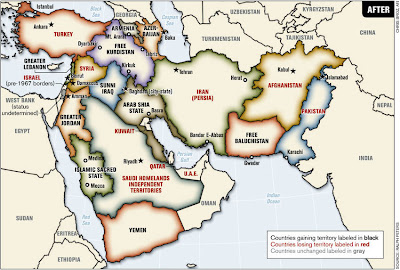 Click to enlarge.
This is a quite insightful article making plain the idiocy of present day geography in the Near East.
 Click to enlarge.
International borders are never completely just. But the degree of injustice they inflict upon those whom frontiers force together or separate makes an enormous difference — often the difference between freedom and oppression, tolerance and atrocity, the rule of law and terrorism, or even peace and war.
The most arbitrary and distorted borders in the world are in Africa and the Middle East. Drawn by self-interested Europeans (who have had sufficient trouble defining their own frontiers), Africa’s borders continue to provoke the deaths of millions of local inhabitants. But the unjust borders in the Middle East — to borrow from Churchill — generate more trouble than can be consumed locally.
While the Middle East has far more problems than dysfunctional borders alone — from cultural stagnation through scandalous inequality to deadly religious extremism — the greatest taboo in striving to understand the region’s comprehensive failure isn’t Islam but the awful-but-sacrosanct international boundaries worshipped by our own diplomats.
Of course, no adjustment of borders, however draconian, could make every minority in the Middle East happy. In some instances, ethnic and religious groups live intermingled and have intermarried. Elsewhere, reunions based on blood or belief might not prove quite as joyous as their current proponents expect. The boundaries projected in the maps accompanying this article redress the wrongs suffered by the most significant “cheated” population groups, such as the Kurds, Baluch and Arab Shia, but still fail to account adequately for Middle Eastern Christians, Bahais, Ismailis, Naqshbandis and many another numerically lesser minorities. And one haunting wrong can never be redressed with a reward of territory: the genocide perpetrated against the Armenians by the dying Ottoman Empire.
Yet, for all the injustices the borders re-imagined here leave unaddressed, without such major boundary revisions, we shall never see a more peaceful Middle East.
Even those who abhor the topic of altering borders would be well-served to engage in an exercise that attempts to conceive a fairer, if still imperfect, amendment of national boundaries between the Bosporus and the Indus. Accepting that international statecraft has never developed effective tools — short of war — for readjusting faulty borders, a mental effort to grasp the Middle East’s “organic” frontiers nonetheless helps us understand the extent of the difficulties we face and will continue to face. We are dealing with colossal, man-made deformities that will not stop generating hatred and violence until they are corrected.
As for those who refuse to “think the unthinkable,” declaring that boundaries must not change and that’s that, it pays to remember that boundaries have never stopped changing through the centuries. Borders have never been static, and many frontiers, from Congo through Kosovo to the Caucasus, are changing even now (as ambassadors and special representatives avert their eyes to study the shine on their wingtips).
Oh, and one other dirty little secret from 5,000 years of history: Ethnic cleansing works.
Begin with the border issue most sensitive to American readers: For Israel to have any hope of living in reasonable peace with its neighbors, it will have to return to its pre-1967 borders — with essential local adjustments for legitimate security concerns. But the issue of the territories surrounding Jerusalem, a city stained with thousands of years of blood, may prove intractable beyond our lifetimes. Where all parties have turned their god into a real-estate tycoon, literal turf battles have a tenacity unrivaled by mere greed for oil wealth or ethnic squabbles. So let us set aside this single overstudied issue and turn to those that are studiously ignored.
The most glaring injustice in the notoriously unjust lands between the Balkan Mountains and the Himalayas is the absence of an independent Kurdish state. There are between 27 million and 36 million Kurds living in contiguous regions in the Middle East (the figures are imprecise because no state has ever allowed an honest census). Greater than the population of present-day Iraq, even the lower figure makes the Kurds the world’s largest ethnic group without a state of its own. Worse, Kurds have been oppressed by every government controlling the hills and mountains where they’ve lived since Xenophon’s day.
The U.S. and its coalition partners missed a glorious chance to begin to correct this injustice after Baghdad’s fall. A Frankenstein’s monster of a state sewn together from ill-fitting parts, Iraq should have been divided into three smaller states immediately. We failed from cowardice and lack of vision, bullying Iraq’s Kurds into supporting the new Iraqi government — which they do wistfully as a quid pro quo for our good will. But were a free plebiscite to be held, make no mistake: Nearly 100 percent of Iraq’s Kurds would vote for independence.
As would the long-suffering Kurds of Turkey, who have endured decades of violent military oppression and a decades-long demotion to “mountain Turks” in an effort to eradicate their identity. While the Kurdish plight at Ankara’s hands has eased somewhat over the past decade, the repression recently intensified again and the eastern fifth of Turkey should be viewed as occupied territory. As for the Kurds of Syria and Iran, they, too, would rush to join an independent Kurdistan if they could. The refusal by the world’s legitimate democracies to champion Kurdish independence is a human-rights sin of omission far worse than the clumsy, minor sins of commission that routinely excite our media. And by the way: A Free Kurdistan, stretching from Diyarbakir through Tabriz, would be the most pro-Western state between Bulgaria and Japan.
A just alignment in the region would leave Iraq’s three Sunni-majority provinces as a truncated state that might eventually choose to unify with a Syria that loses its littoral to a Mediterranean-oriented Greater Lebanon: Phoenecia reborn. The Shia south of old Iraq would form the basis of an Arab Shia State rimming much of the Persian Gulf. Jordan would retain its current territory, with some southward expansion at Saudi expense. For its part, the unnatural state of Saudi Arabia would suffer as great a dismantling as Pakistan.
A root cause of the broad stagnation in the Muslim world is the Saudi royal family’s treatment of Mecca and Medina as their fiefdom. With Islam’s holiest shrines under the police-state control of one of the world’s most bigoted and oppressive regimes — a regime that commands vast, unearned oil wealth — the Saudis have been able to project their Wahhabi vision of a disciplinarian, intolerant faith far beyond their borders. The rise of the Saudis to wealth and, consequently, influence has been the worst thing to happen to the Muslim world as a whole since the time of the Prophet, and the worst thing to happen to Arabs since the Ottoman (if not the Mongol) conquest.
While non-Muslims could not effect a change in the control of Islam’s holy cities, imagine how much healthier the Muslim world might become were Mecca and Medina ruled by a rotating council representative of the world’s major Muslim schools and movements in an Islamic Sacred State — a sort of Muslim super-Vatican — where the future of a great faith might be debated rather than merely decreed. True justice — which we might not like — would also give Saudi Arabia’s coastal oil fields to the Shia Arabs who populate that subregion, while a southeastern quadrant would go to Yemen. Confined to a rump Saudi Homelands Independent Territory around Riyadh, the House of Saud would be capable of far less mischief toward Islam and the world.
Iran, a state with madcap boundaries, would lose a great deal of territory to Unified Azerbaijan, Free Kurdistan, the Arab Shia State and Free Baluchistan, but would gain the provinces around Herat in today’s Afghanistan — a region with a historical and linguistic affinity for Persia. Iran would, in effect, become an ethnic Persian state again, with the most difficult question being whether or not it should keep the port of Bandar Abbas or surrender it to the Arab Shia State.
What Afghanistan would lose to Persia in the west, it would gain in the east, as Pakistan’s Northwest Frontier tribes would be reunited with their Afghan brethren (the point of this exercise is not to draw maps as we would like them but as local populations would prefer them). Pakistan, another unnatural state, would also lose its Baluch territory to Free Baluchistan. The remaining “natural” Pakistan would lie entirely east of the Indus, except for a westward spur near Karachi.
The city-states of the United Arab Emirates would have a mixed fate — as they probably will in reality. Some might be incorporated in the Arab Shia State ringing much of the Persian Gulf (a state more likely to evolve as a counterbalance to, rather than an ally of, Persian Iran). Since all puritanical cultures are hypocritical, Dubai, of necessity, would be allowed to retain its playground status for rich debauchees. Kuwait would remain within its current borders, as would Oman.
In each case, this hypothetical redrawing of boundaries reflects ethnic affinities and religious communalism — in some cases, both. Of course, if we could wave a magic wand and amend the borders under discussion, we would certainly prefer to do so selectively. Yet, studying the revised map, in contrast to the map illustrating today’s boundaries, offers some sense of the great wrongs borders drawn by Frenchmen and Englishmen in the 20th century did to a region struggling to emerge from the humiliations and defeats of the 19th century.
Correcting borders to reflect the will of the people may be impossible. For now. But given time — and the inevitable attendant bloodshed — new and natural borders will emerge. Babylon has fallen more than once.
Meanwhile, our men and women in uniform will continue to fight for security from terrorism, for the prospect of democracy and for access to oil supplies in a region that is destined to fight itself. The current human divisions and forced unions between Ankara and Karachi, taken together with the region’s self-inflicted woes, form as perfect a breeding ground for religious extremism, a culture of blame and the recruitment of terrorists as anyone could design. Where men and women look ruefully at their borders, they look enthusiastically for enemies.
From the world’s oversupply of terrorists to its paucity of energy supplies, the current deformations of the Middle East promise a worsening, not an improving, situation. In a region where only the worst aspects of nationalism ever took hold and where the most debased aspects of religion threaten to dominate a disappointed faith, the U.S., its allies and, above all, our armed forces can look for crises without end. While Iraq may provide a counterexample of hope — if we do not quit its soil prematurely — the rest of this vast region offers worsening problems on almost every front.
If the borders of the greater Middle East cannot be amended to reflect the natural ties of blood and faith, we may take it as an article of faith that a portion of the bloodshed in the region will continue to be our own.
04 July, 2011
Farrenkopf on the fragility of the Pax Americana
Exactly ten years ago (and, it is worth noting, before the Outrage of 11 September 2001), John Farrenkopf wrote a lengthy analysis of the philosophy and works of Oswald Spengler, Prophet of Decline. I read it when it came out and was quite impressed however, picking it up again after the passage of a decade, I am pleased to see how well it has stood up. In commenting on Spengler's prediction of a twenty-first century Pax Americana, roughly synonymous with the Pax Romana of the first and second centuries AD. Farrenkopf uses his knowledge of current events and Spengler's method to produce this remarkably prescient prediction of what has actually happened in the last ten years:
The decline of American hegemonic power is inevitable as twilight begins to spread its shadows over the Pax Americana. The American neo-imperial world order will prove in the twenty-first century to be a transitory affair. In its home country the signs of sociological decay are already unmistakable in the break-down of the family structure and growing social pathologies, the spread of quasi- pacifism, and the unabashed excesses of our sensate culture. Despite the remarkable economic prosperity of the 1990’s, causes for anxiety abound. The fiscal burdens of the welfare state compounded by and aging society, the massive current-accounts deficits, frenzied speculation, and the recurrent instabilities of the global economy portend an eventual economic crisis for the United States. Effective governance already facesthe multiple challenges of interest groups subverting the public interest, plutocratic tendencies, the necessity of coping with unprecedented ethnic diversity, and growing political apathy, if not disgust. The erosion of America’s ability to exercise leadership in world affairs and manage world order is only a matter of time. The fragile Pax Americana will not have the impressive staying power of the Pax Romana.

02 July, 2011

16 June, 2011


Subscribe to:
Posts (Atom)
